
That Clicking Noise When You Turn? It’s Your Axle Telling You Something’s Wrong
You’ve been hearing it for weeks—that rhythmic clicking sound when you turn into a parking space, the vibration through your steering wheel when accelerating, or grease splattered inside your wheel well. Maybe your car shudders and clunks when shifting into drive.
Ignoring these signs won’t make them go away. These symptoms often point to CV joint failure or axle damage, and delaying repairs only makes the problem worse. Left unchecked, axle issues can lead to complete failure, putting you and your family at risk.
The good news? When caught early, axle repairs are straightforward and cost-effective. At Monsoon Automotive, we specialize in diagnosing and repairing axle problems, restoring your vehicle’s safety and your peace of mind.
Why Your Vehicle’s Axles Matter
Your axles transfer power from your engine to your wheels, allowing your car to move and turn safely. When axles or CV joints fail, you’re not just dealing with an inconvenience—you’re driving a vehicle that could leave you stranded or cause an accident.
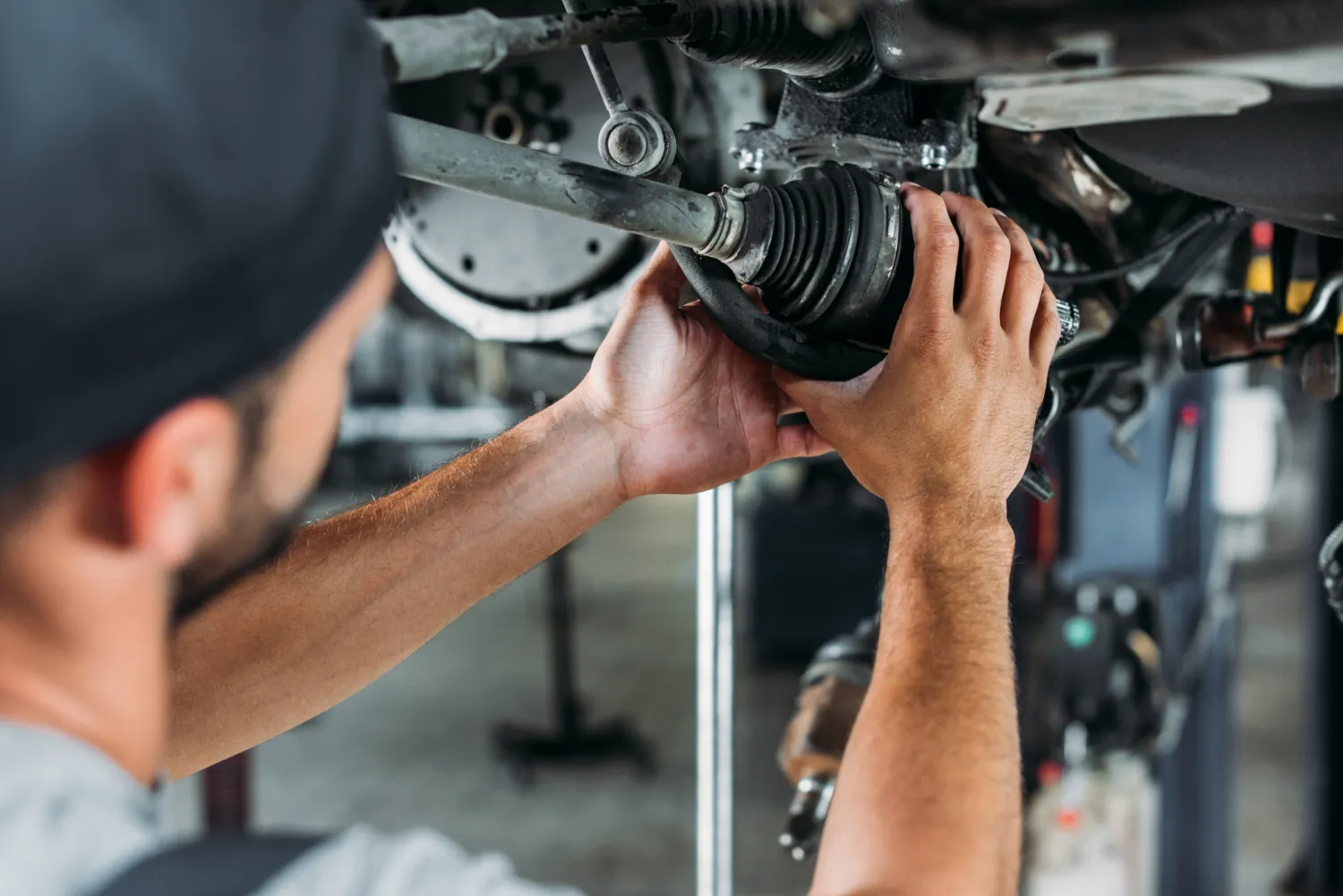
In front-wheel-drive vehicles, axles must transmit power while accommodating the steering angle of your wheels. CV (Constant Velocity) joints allow the axle to flex and bend while maintaining a constant rotational speed, ensuring smooth power delivery even at sharp angles. These joints are protected by rubber boots filled with grease, which lubricates the intricate ball bearings inside. When these boots tear, grease escapes, and contaminants enter, leading to rapid wear and the clicking, popping, and vibration symptoms drivers often notice.
In rear-wheel-drive and all-wheel-drive vehicles, axles handle engine torque while supporting the vehicle’s weight and absorbing road impacts. A bent or damaged axle affects wheel alignment, causes unusual tire wear, and creates vibrations that worsen over time.
Warning Signs You Shouldn’t Ignore
- Clicking or popping sounds during turns: A torn CV boot allows grease to leak out and contaminants to enter, causing metal components to grind and click.
- Vibrations during acceleration: A bent axle or worn CV joint creates imbalance, leading to vibrations felt through the steering wheel or floorboard.
- Grease on your tires or wheels: A torn CV boot flings grease outward, leading to rapid joint deterioration.
- Loud clunking when shifting gears: This indicates significant axle or CV joint damage and suggests you’re nearing complete failure.
- Resistance or difficulty turning: A deteriorated CV joint can bind, affecting your vehicle’s handling and safety.
The clicking sound during turns occurs because the CV joint’s internal components are no longer properly lubricated. Vibrations during acceleration often indicate a bent axle or worn CV joint, creating imbalance. Grease splattered on your tires or wheel wells confirms CV boot failure, while loud clunking during gear shifts signals advanced wear and imminent failure.
The Cost of Waiting
Delaying repairs worsens the damage and increases costs. A torn CV boot that could have been replaced for a few hundred dollars can escalate to a full CV joint replacement. Worse, complete axle failure while driving can cause loss of power, leaving you stranded or in a dangerous situation.
Axle and CV joint damage progresses predictably. It starts with a small tear in the protective boot, allowing grease to escape and contaminants to enter. Over time, the joint’s internal components wear down, leading to clicking, grinding, and eventual failure. Waiting to repair axle problems also stresses other components, such as wheel bearings and suspension parts, increasing repair costs.
Why Tucson Trusts Monsoon Automotive
At Monsoon Automotive, we understand you’re not just looking for a repair—you’re looking for a mechanic you can trust. We’ve built our reputation on honesty, transparency, and quality workmanship.
Tucson’s unique driving conditions demand a repair shop that understands local challenges. Our monsoon season brings sudden flooding that can damage CV boots and axle seals. Our summer heat ages rubber components faster than in milder climates. The combination of desert dust and occasional rain creates an abrasive mixture that accelerates wear on exposed drivetrain components. We see these issues every day and know exactly how to address them.
Honest Diagnosis You Can Understand
We start with a comprehensive inspection and show you exactly what’s wrong. You’ll see the torn CV boot, the grease leakage, or the play in the joint. We explain everything in plain language, so you can make informed decisions without feeling pressured or confused.
Our diagnostic process begins with listening to your concerns and taking a test drive to experience the symptoms firsthand. We then lift your vehicle to inspect the axles, CV joints, and boots visually. We check for play by grasping the axle and attempting to move it in directions it shouldn’t move. We rotate the wheels by hand while listening for grinding or clicking sounds.
When we find issues, we don’t just tell you about them—we show you. We’ll point out the torn boot, show you the grease splatter, and demonstrate the excessive play in the joint. This transparency ensures you understand exactly what’s wrong and why the repair is necessary.
Quality Parts and Workmanship
We use premium parts that meet or exceed OEM standards. Our ASE-certified technicians have decades of experience with all makes and models, ensuring your repair is done right the first time.
At Monsoon Automotive, we source axles and CV joints from manufacturers known for quality and reliability. These parts feature precision-machined components, high-grade steel construction, and properly formulated grease designed to withstand Tucson’s temperature extremes. The CV boots are made from durable materials that resist cracking and tearing, even under Arizona’s UV exposure and temperature cycling.
Our technicians understand the nuances of different vehicle designs—the specific torque specifications for axle nuts, the proper techniques for compressing CV joint boots, and the importance of checking wheel bearing condition during axle replacement. They know which vehicles require special tools or procedures and how to avoid damaging ABS sensors or other components during the repair process.
A Repair Process Designed for Your Peace of Mind
From inspection to road testing, we follow manufacturer specifications and perform quality control checks to ensure your vehicle is safe and symptom-free.
Our repair process begins by safely lifting and supporting your vehicle. We remove the wheel and brake components as necessary to access the axle. For front-wheel-drive vehicles, this typically involves disconnecting the tie rod end, separating the lower ball joint, and carefully extracting the axle from the transmission and wheel hub.
During removal, we inspect related components, such as wheel bearings, ball joints, and suspension bushings. If we discover additional wear or damage, we’ll contact you before proceeding. We also inspect the transmission or differential seal for leaks, as replacing this seal during axle replacement is far more cost-effective than addressing it later.
Installation of the new axle or CV joint requires precision. We ensure proper seating in both the transmission and wheel hub, torque all fasteners to manufacturer specifications, and verify that the axle rotates smoothly without binding. After reassembly, we perform a final inspection and road test to confirm that all symptoms have been resolved.
Common Axle Repairs We Perform
- CV Joint Replacement: Replacing the joint assembly restores smooth operation when the protective boot has failed.
- Complete Axle Replacement: Necessary for bent or severely damaged axles, often caused by potholes, curbs, or accidents.
- CV Boot Replacement: A cost-effective option if the boot is torn but the joint remains undamaged.
- Axle Seal Replacement: Prevents fluid leaks that could damage your transmission or differential.
- 4WD and AWD Axle Service: Specialized repairs for complex systems with multiple axles and components.
CV joint replacement is our most common axle-related service. When the protective boot has been torn for an extended period and the joint shows signs of wear—clicking, grinding, or excessive play—replacing the entire joint assembly is the most reliable solution.
Complete axle replacement becomes necessary when the axle shaft itself is damaged. This can occur from impact with road hazards, accidents, or severe CV joint failure. Replacing the entire axle assembly ensures your vehicle’s drivetrain operates as designed.
CV boot replacement is a preventive service that can save you significant money when performed at the right time. If you catch a torn boot before the CV joint has been contaminated, we can replace just the boot, repack the joint with fresh grease, and restore the protective seal.
Axle seal replacement addresses leaks at the point where the axle enters the transmission or differential. These seals prevent gear oil or transmission fluid from escaping and keep contaminants from entering.
Four-wheel-drive and all-wheel-drive vehicles present additional complexity. These systems often have front and rear axles, transfer cases, and additional driveline components that must all work together. We have the specialized knowledge and tools to service these systems, whether you drive a truck, SUV, or AWD car.
Two Convenient Tucson Locations
Visit us at 6722 East Tanque Verde Road, Tucson, AZ 85715. Our fully equipped facilities and experienced team are ready to handle all your axle repair needs.
Our location on East Tanque Verde Road serves Tucson’s east side and surrounding communities. We’ve invested in modern diagnostic equipment, quality tools, and a comfortable waiting area because we want your experience to be as pleasant as possible.
How much will this cost me? The cost of axle repairs varies depending on your vehicle’s make, model, and the extent of the damage. During your inspection, we’ll provide a detailed estimate specific to your vehicle before beginning any work.
Can I keep driving with a bad CV joint or axle? You shouldn’t. A clicking CV joint or damaged axle will continue to deteriorate, risking complete failure and loss of control.
Do I need to replace both axles? Not necessarily. We assess each axle independently and only recommend replacing what’s necessary.
How long will the repair take? Most axle repairs take 2″“4 hours, depending on your vehicle’s design and the specific repair needed.
What causes axles and CV joints to fail? Common causes include torn CV boots, rough roads, aggressive driving, and lack of maintenance.
Will this repair fix my vibration problem? If the vibration is caused by a damaged axle or CV joint, yes. However, vibrations can also result from unbalanced tires or alignment issues.
How can I prevent axle problems in the future? Regular inspections during routine maintenance help catch CV boot tears before they cause joint damage.
Stop Worrying and Start Driving With Confidence
Don’t let that clicking sound or vibration turn into a costly breakdown. At Monsoon Automotive, we’re committed to providing honest, professional service that keeps you and your family safe.
Call us today at (520) 305-4908 to schedule your axle inspection. Visit our facility at 6722 East Tanque Verde Road, Tucson, AZ 85715, and let us show you the difference that trust and quality make.